Chinese car brands are no longer a niche in Belgium and Europe: they often offer more equipment, strong EV technology, and rapid innovation. Discover what that means for TCO, residual value, and the best leasing formula for your business.
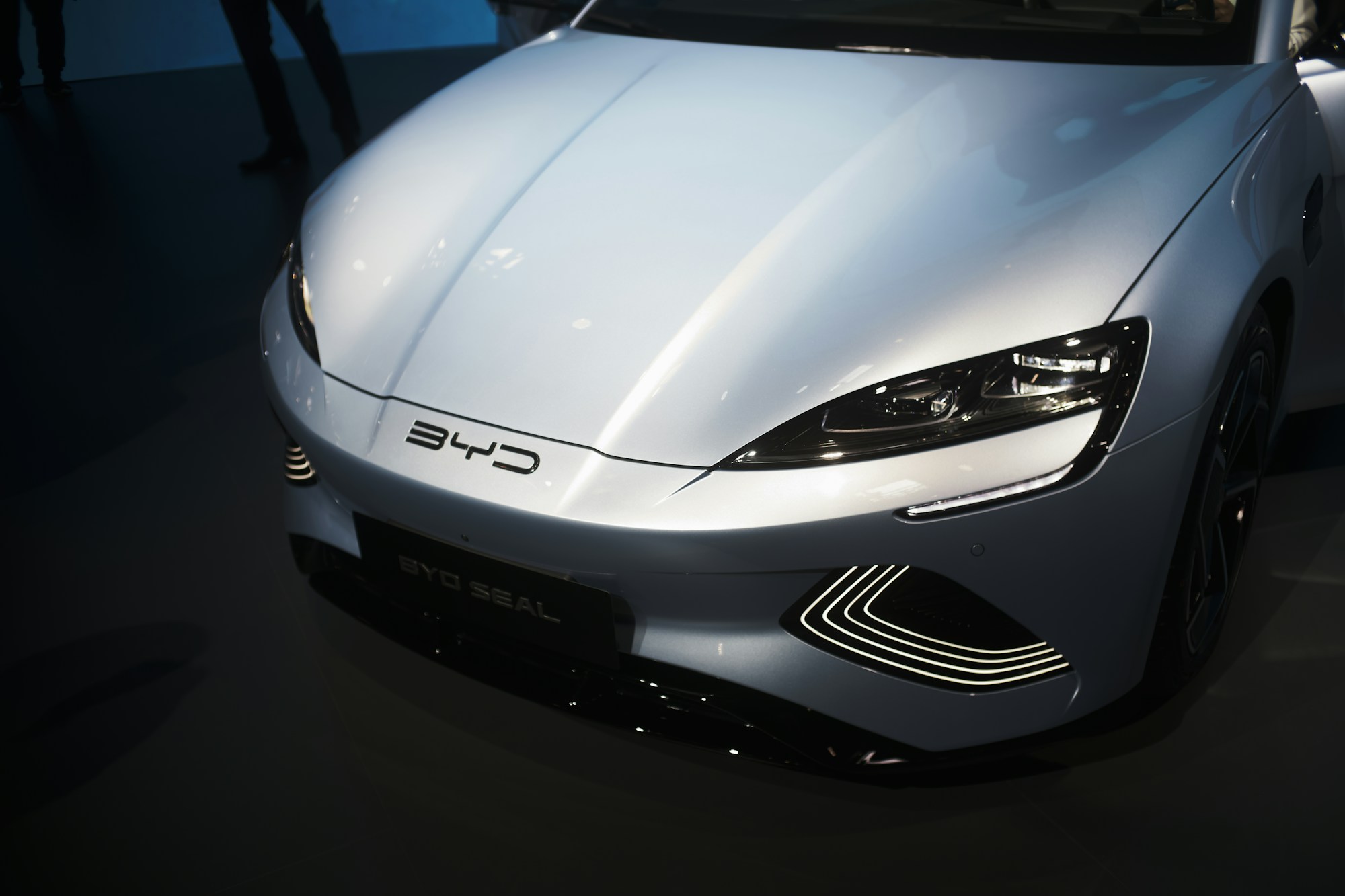
Chinese car brands are no longer a niche in Belgium and Europe. They stand out more prominently at trade shows, appear more frequently in showroom streets, and are increasingly on the shortlist of entrepreneurs. This rising popularity fits into a broader Chinese advance in the European market, where Asian car brands are becoming increasingly visible.
This was also very tangible at the Brussels Motor Show 2026 (January 9–18, 2026): according to the official exhibitor list, there were remarkably many Chinese (and Chinese-connected) brands among the 67 car brands present, with names such as BYD, Nio, Xpeng, Zeekr, Omoda, Jaecoo, BAIC, Maxus, and MG. In addition, you also see other Chinese car manufacturers and sub-brands emerging in Europe, such as Leapmotor, Hongqi, Geely Auto, and Lynk & Co.
The question is therefore no longer whether Chinese brands are playing along, but above all: why are they becoming more popular than European counterparts and European competitors, and what does that mean for your leasing choice as an entrepreneur?
Why Chinese brands are growing so fast in popularity
There are several reasons why Chinese car brands are gaining ground faster than many European manufacturers expect. It is rarely about a single "magic bullet", but about a mix of pace, technology, and positioning—with real breakthroughs in software, batteries, and product development. It also helps that many of these groups as a Chinese company or Chinese group can scale up very quickly, with brand-new models incredibly fast (from compact cars to SUVs) for diverse needs on Dutch roads and beyond.
1) More car for your money, often with richer equipment
Many Chinese models are put on the market with high standard equipment: advanced driver assistance systems, large infotainment screens, comprehensive cameras, and premium-looking interiors with an sometimes remarkably refined style.
That does not mean they are always "cheaper" on the invoice, but it does mean that the price-quality perception is strong: you quickly compare a richly equipped Chinese version with a European version for which you still have to tick options. For some entrepreneurs, affordability also plays a role, especially when you lease multiple cars at the same time.
2) Electrification as a core, not as a side project
Where some European brands build out their electric line-up step by step, electrification is a core strategy for many Chinese groups. You notice this in charging speeds, battery management, software updates, and the range of EVs and (plug-in) hybrids (plug-in). The overall performance (acceleration, efficiency) and sometimes even extra driving pleasure, agility, and silence in the cabin also make these models attractive for business drivers.
At the Brussels Motor Show 2026, BYD underlines this, for example, with a wide line-up and demos around technology such as V2L (vehicle-to-load). At the same time, you see brands like Nio focusing heavily on software experience and ecosystem, while other players aim primarily at price/equipment and scale.
3) Speed: shorter development cycles and fast model updates
Chinese car brands iterate quickly: new models and facelifts follow each other faster. For you as a company, that can have two sides:
Pro: you get new technology and features faster.
Con: residual values (restwaardes) can become more sensitive if a "newer, better" version comes along very quickly.
That is why it pays to choose your leasing formula wisely, especially if your fleet needs to remain predictable in terms of costs.
Are Chinese cars "really" cheaper than European ones?
Sometimes yes, often more nuanced. The right comparison is not just list price vs list price, but TCO (total cost of ownership): monthly cost, insurance, maintenance, consumption/electricity, tires, taxes, any charging solution, and residual value.
The table below shows how best to look at the comparison when you lease for business.
Point of comparison | Chinese brands (typical) | European brands (typical) | What that means for your lease |
|---|---|---|---|
Purchase price | Regularly competitively positioned | Often higher with equal equipment | Can result in a lower monthly price, but depends on residual value |
Standard equipment | Often very complete | More often option-driven | Fewer surprises: easier budgeting |
Technology (EV/battery/software) | Strong, rapidly evolving | Strong, but sometimes slower in updates | Choose a formula that fits rapid innovation (e.g. operational leasing) |
Aftersales & network | In development, brand-dependent | Usually broad and established | Service and turnaround time can be crucial for uptime |
Residual value | Still in development, more uncertain | Historically more stable | Residual value risk weighs heavily on your monthly cost |
If you manage a car fleet today (or just need one company car), the choice is less and less about "China vs Europe", and more and more about: which contract limits your risks and keeps your cash flow healthy?
Here are three practical situations where we see the impact most often.
1) You want maximum predictability in your monthly cost
In that case, a formula with maintenance and insurance included is interesting, especially if you notice that service networks are still growing.
At LeaseBroker, this often fits within operational leasing, where your monthly cost can be all-in (depending on the package and partner).
2) You eventually want to become the owner (but without a heavy initial investment)
If you prefer to work towards ownership, but want to preserve your liquidity, then a formula with a purchase option at the end often fits better, such as:
financial leasing (with purchase option)
financial renting (depending on accounting preferences)
hire-purchase (low residual value, owner at the end)
halal lease (interest-free financing with purchase option)
This is especially relevant when you expect the vehicle to remain in your company for a long time and you want to manage the depreciation well—also with newer Chinese car models that still have to "prove" themselves in terms of residual value and long-term reliability (service, parts, engine-related components in hybrids, etc.).
3) You want to free up capital (while continuing to use your assets)
Do you already own vehicles or machinery and want to free up cash to invest (for example in charging infrastructure, expansion, or working capital)? Then sale-and-leaseback can be interesting: you temporarily sell your equipment to a finance company and lease it back.
Smart checklist before you lease an EV
Keep it simple and business-oriented. This short checklist helps you choose the right formula faster:
Determine your usage: mileage, trip types, cargo, drivers (single driver or pool).
Check service and parts: where is the nearest service point, and what are average turnaround times?
Choose your risk profile: do you want to bear the residual value risk (closer to financial leasing) or outsource it (closer to operational leasing)?
Think about scalability: might your fleet grow within 6–18 months? Then flexibility is extra important.
Compare on TCO, not on price: monthly cost + energy + insurance + tires + downtime risk.
How LeaseBroker helps you choose without guesswork
LeaseBroker is a financial partner that helps you to choose the best financing option for your situation, whether you choose a Chinese brand (such as BYD, Nio, Leapmotor, Hongqi, Geely Auto, or Lynk & Co), a European classic with tradition and craftsmanship, or a mix in your fleet. Also for questions regarding car import (and the practical impact on registration, delivery time, and service), we are happy to provide advice to ensure your transition runs smoothly.
Want to know quickly what works best for you? Start with a quote request and compare based on your usage and budget. Get in contact with LeaseBroker. Our team of experts is ready to discuss your specific needs and find the ideal financing solution for your situation. Call us at 0800 21 039 or email info@lease-broker.com to make an appointment.